May 7, 2010

Spring Chores

Hello everyone,

The winds have changed and while they are gusting as hard as ever they are of the milder variety rather than the deep arctic chill we get during early fall through late spring. Now that the weather is steadily warming we can expect maybe another snow squall, or a few more hard frosts but over all we should see daytime highs stay above 40 at least until next August.

Getting spring fever and keeping the warming temperatures in mind we started a new, albeit small project, making a new clothes line so that I can start to hang the laundry outside and save some of our hard earned money from the rising cost of electricity. (Thank You Pres. Obama and your Climate Change Bill... but I digress)

Now most of you out there are probably laughing saying to yourself that you make a clothes line by stringing a rope between two trees and call it a day, that's not a project right? Well in most areas of the country you would be right, but up here in northern Maine most of the trees are pine trees and they are not exactly conducive to clothes hanging on a line, that is of course unless you like your clothes to stand up on their own.

So here we have to construct free standing clothes lines. You can buy a metal free standing clothes line at just about any discount department store out there for around $75. But doing so would not be very homesteading survivalist friendly now would it? So being people who practice what we preach we headed back to our back 80 and searched out some acceptable tamarack to use for out building material. Tamarack is a wonderful tree that is a cousin to the cedar and therefore will probably outlast me in longevity. We're cutting some more tamarack down for fencing the front 10 acres in near our road, but that's a whole other story.

If I were really ambitious I suppose I could have went down to the creek and took some reeds and braided a rope to hang the clothes from and my husband could have took the time to shape wooden spikes to hold the whole thing together but instead we took the easy road and bought the rope from Walmart and we found some old screws hanging around the house to use. So we'll say the clothes line cost less than $10 total to make it, and it holds about four loads of laundry at a time.

So we started by getting the tamarack poles.


And then digging the holes where we want the poles to go, and placing them in.


We cut out notches so the poles would go together and have enough strength to hold even the heaviest wettest blankets. It also helped us to make the structure level.

We screwed in the cross braces and drilled holes for the line to go through.


Simple, rustic, and not all together to terrible to look at as far as clothes lines go. We're proud of it and we applied our homesteading principles to doing it, so all in all a win win for the weekend.


Hopefully my next post will be showing us put in the new garden step by step from breaking ground to planting seed. Until then,

Thank You, and God Bless.

Apr 27, 2010

Rotational Gardening

Hello Everyone,

So this morning it snowed. Not a lot of snow just a squall. Enough to coat the grass and remind us that no matter how nice the weather gets during the day it is still April in northern Maine and our last frost date is June 15 regardless how early the flowers blossom or the trees don leaves.

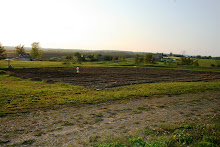
One good thing about the unexpected nice early nice weather this year is that we are implementing rotational gardening this year. When we first came to this property there was no vegetable garden at all. The farm had been used for commercial potato farming years ago and had been planted in hay and clover to improve it's soil quality before it was foreclosed on. So what we bought was a farm who's fields were in total dismay from not being worked for years. We've been slowly reclaiming those fields one half acre at a time.

So upon arriving on the property I proudly proclaimed that our vegetable garden was going to go behind the house and promptly began marking it out. Next was to till all that nice green turf and turn over the ground and start making a garden out of the space. Of course I knew next to nothing about gardening at the time. If i did I would have walked myself up the hill to my front field and made the garden there instead of in my back yard.

In one way it was a good thing because we actually got a yield out of the garden our first year. That in it's self shows the kind of determination we have to make this work. Vegetables do grow out of grass just not well, and no matter how many rocks you pick up when starting a garden there will always be thousands more that still need to be picked up. Our first year here we got so much rain that the extra grass we had in our garden that we just couldn't get rid of no matter how hard we tried helped soak up a lot of that excess water and actually gave us a better tomato harvest than most of our neighbors.

The second year however was a different story. We not only had the excess grass to contend with but we also started to get out of control with the weeds not to mention our soil quality was lacking since the plot used to be lawn not garden. We had a lot going against us but we still managed to sell some vegies and put up a harvest large enough for the year and to give away to friends and reletives. It just wasn't pretty to look at that's for sure.

Also during the second year we began to get more and more bugs throughout the season. This was discouraging because I refuse to start spraying chemicals in my garden. A little soap here and there fine but store bought pesticides no way. All the farmers and neighbors around here use the chemicals so they could offer no help. So I did what any good homesteader does and hit the books. Of course these were the same books that showed depictions of people digging up lawns and starting gardens that look like they belong in a Better Homes and Gardens magazine their first year, but none the less where else could I turn?

That's when I read about rotational gardening as a means to improve soil quality and as a form of pest control. The more I read the more I knew this was for us. It implaments the practices of soil conservation and amendment and it takes care of the excess bugs without using chemical pesticides. So this year we are bidding our 150'x100' current garden goodbye... at least for the next two years, and are instead penning the chicken there for the next two years. There the chickens will dig, scratch and kill all the pesky grass that just keeps coming back for us. Then they will eat all the bugs in each life-cycle form while providing my poor soil with rich free fertilizer. So when I come back to this garden spot two years from now it will be greatly improved and in need of some rock clearing but not much else. The chickens will then move to the garden spot that we will be making this year next to the apple orchard in actual farm soil.

We never documented the creation of our first garden for the website so this time I plan to take pictures and show what we are doing. Now that I won't have the competition of growing grass maybe I'll even get the time to take some more pictures of the garden growing. All in all I think this year will be a better year for the garden and I'll be keeping everyone up on how the rotational gardening is going. Now if it would only stop snowing :)